Frequently Asked Questions
GROUND
What is that upside-down triangle -
is that ground?

Yes, it is ground.
Where do the connections that show a
ground symbol go to?
Generally speaking, take all the
ground points, connect them together, then connect them to the ground lug of
the input or output jack. Take the power supply (i.e. battery) and connect it
to the ground lug as well. If you want the input jack to switch your battery on
and off, then connect the lug to ground as before, but connect the battery
terminal to the middle connector (i.e. "ring")of a stereo jack. When
a mono plug is inserted, the ground circuit will be complete and the switch
will be on. Note that some circuits connect the + or positive terminal of the
battery to ground (positive ground circuit), although it is more common to
connect the negative terminal to ground. The sleeves of the input and output
jacks usually go to ground as they are usually connected to the metal casing
and the ground lug - unless they are isolated jacks (in which case you need to
ground both jack sleeves with a ground wire). In general, metal jacks are not
isolated from metal enclosures. If your box is painted you might consider
scraping off some paint so the jacks can make contact with the metal on the box
so the box can act as a shield; lock washers may do this as well.
POTS
Pots - How do I wire pots?
Apparently there's a standard for
the terminals. When looking at the back of the pot (side opposite the shaft
sticking out) with the terminals facing left, from top to bottom they are
labeled 3,2 and 1. The terminals correspond to the schematic terminal wires.

When viewed from the front, a pot
turned fully clockwise connects terminal 2 to terminal 3. Fully
counterclockwise connects terminal 2 to terminal 1.Anyway, I know I have
connected pots like this but they were still backwards. If that happens, simply
swap the wires connected to terminals 3 and 1.
Pots - When do I use audio or linear
taper pots?
You can use either one at any time.
The taper may not be as optimum on some applications. The basic rule of thumb
is use audio for volume and sometimes drive, use linear for everything else.
That being said, you can use linear for everything. Linear pots will always
"work". You can also turn a linear pot into a psuedo audio pot - read
the next question.
Pots - What is the difference
between linear and log or audio taper and how do pots work?
Pots - I'm looking at a pot with the
stem pointing at me. On the left side there is this little metal bit that
sticks up. Why is that there?
From Joe Gagan: Some electronics
manufacturers cast or drill a little hole in their enclosure to receive that
tab on the pot as an additional anti-spin technology. You can either add that
hole yourself, or break off the little tab with some pliers like most of us
around here do.
Pots - How can I test a pot to see
if it's linear or log taper?
From paul perry (Frostwave):Just put
the shaft to half way. If it is linear, then it should measure the same value
each way to the ends.(from wiper/middle to each outer lug) If not, it is log.
CAPACITORS
Here is a picture of various types
of capacitors. Picture courtesy of Brad Fajardo

The most common types are
Ceramic(they are cheap and generally used for small values), PolyesterFilm
(common at Radio Shack) and Electrolytic. The other typescan be used but are
more expensive. Electrolytics are polarized;i.e. they have positive and negative
terminals, just like a battery.
There are two very common packages
of electrolytics that you will run into; Axial and Radial. As you can see
below, the difference is where the leads exit the capacitor. I like Radials
because they take up less space on the board.

This is what a typical electrolytic
capacitor looks like. The side shown is the NEGATIVE side of the electrolytic.
I have read in books that the the positive side is sometimes marked, but so far
I have only seen the negative side marked in the capacitors I buy in the local
stores.
 Radial capacitor with negative side showing.
Note the 16V on the electrolytic,
this is the voltage rating of the capacitor. For our stompboxes,16V or 35V or
anywhere in between is fine,. When you shop around, try and get the cheapest
capacitor in this range. Sometimes the 35V will be cheaper than the 16V. Save
money and buy the less expensive one.You can use any voltage capacitor as long
as the voltage of the circuit you are using doesn't exceed the voltage rating.
As long as you can fit the capacitor and the voltage rating is fine, you can
use it.
Here are some common electrolytic
symbols that you may encounter. In the following example, the negative lead
would be facing down and the positive lead facing up.

Capacitors (AKA Cap)- What kind of
capacitors should I use?
In a nutshell, you should use
electrolytic when the capacitor is polarized. You can also use tantalum
capacitors instead of electrolytic, but these are not commonly used. For any
others, the basic consensus is to use film caps if they fit, otherwise use a
mixture of film and ceramic capacitors. For most of our circuits, use caps with
a minimum 16 volt rating. R.G. posted a great
explanation about the subjective world of
capacitors. For distortion circuits, others have noted that cheap ceramics
sound good too, so use your ears! In general, 1uF and up will be electrolytic,
any smaller values up to .001uF can be film types and picofarad values like
10pf-470pf are usually ceramic types. This is usually due to size, cost and
availability. With the exception of elecrolytic and tantalum capacitors, most
capacitors such as film or ceramic are non-polarized (often labeled NP). The
orientation of a non-polarized capacitor doesn't matter; there's no positive or
negative.
An interesting point to consider is
that most vintage pedals used cheapo ceramic disks.
Capacitor - I can't find xx uF
capacitor!
You can put two or more capacitors
in parallel and their values will add up. This way you can substitute common
cap values for hard to find ones. For example: for a 20uF cap, you can put two
10uF caps in parallel.
Capacitors - I saw this weird
capacitor symbol on a schematic, it had plus signs on both sides! What is this?
It's a non-polarized capacitor often
labeled.From Jack Orman:You can simulate a non-polarized by using 2
electrolytic caps. Connect them together negative to negative and use the
positive leads as the component leads; which is probably why someone notated it
as +-||--||-+
From R.G.
"You can make a quick and dirty
NP cap by tying together the negatives of two equal-sized polar caps.
In the series-NP connection, the
capacitance value is funny. Normally caps in series are a smaller capacitance
than either cap by itself. If you had two 3.3uF polyester caps, then the expected
value for two of them in series is 1.65uF. However, electrolytic caps actually
conduct in the reverse direction, so two 3.3uF polarized aluminum electrolytic
caps act like they each have a diode in parallel with them that conducts when
the voltage is backwards for that one cap. So two 3.3uF caps hooked up as
series non polar (i.e. negative to negative) look like a single 3.3uF NP cap.
... except for tiny region near zero
volts where they withstand a tiny reverse voltage, so they look like 1.65uF
there..."
Capacitors - I don't really
understand the units of measurements.... uF, pF etc....
Capacitors - Can I put a non
polarized capacitor in place of an electrolytic (one that has plus and minus
signs)?
Yes you can. It's more troublesome
to do the other way - to put an electrolytic in place of a normal capacitor
since you have to orient the capacitor the correct way or bad things could
happen. Don't do this on high power circuits though. For most 9V stompboxes,
this should be fine. How do you know which way to orient the polarized cap? The
connection point with the larger voltage faces the positive side of the cap.
(Use your meter)
Capacitor - In general - how do I
orient an electrolytic capacitor?
The positive side of the polarized
capacitor goes to the side (connection point) with the higher voltage. (Use
your meter to see which connection point has the higher voltage.)
How do you switch between different
input caps?
From Mark Hammer:
There are several ways to do so.
There are two principles to keep in mind:
1) Caps store charge, so when caps that have charge stored
with nowhere to "bleed off" are reconnected again, there will be a
surge of charge being drained that you will hear as a pop. This is why some
pedals with a "hanging" cap at the inpt or output will pop with a
true bypass (straight wire) unless there is a bleed-off resistor to ground.
Bottom line - you don't really want to have any caps with free ends if you can
help it.
2) Capacitance is additive in parallel not in series. In
series it behaves like resistors in parallel.
So, if you want to switch caps *without* popping, the smart
way to do it is to do something like what John Hollis did on the Zombie Chorus.
The cap that sets the clock speed is actually two .001uf caps in series. As a
pair of series caps, their effective capacitance is actually 500pf (like I
said, caps in series behave like resistors in parallel). Shunting out one of those
caps with a SPST switch turns it into one .001uf cap when the other is
bypassed. For a Rangemaster bottom-cut or "fat" switch, you start out
with two equal value series caps chosen so that *half* the value of one of them
is equal to the stock input capacitor. When you shunt one of the caps (either
one will do), the effective capacitance now becomes doubled and the lowend
rolloff drops by an octave to fatten things up.
I should emphasize that this method is one you would use if
complete and total avoidance of popping is your objective, for instance if you
wanted a "fat" switch to be a stompswitch you could use mid-riff. If
your intention is to have it be a set-and-forget function, then a little
popping during breaks won't kill anyone and you can consider other options.
The "other" options include having something like
a 6-position rotary switch that adds other caps in parallel with the stock one
to achieve larger effective capacitances and drop the low-end rolloff even
further down. Quite frankly, I wouldn't see much value in going beyond 3
settings, but it's your perogative. Three settings could be easily attainable
by using a 3-position (centre-off) SPDT toggle-switch. The middle position of
the switch adds no additional cap, and the two outside add one of two other
values in parallel to achieve 3 different effective input cap values. The
drawback with this is that it doesn't lend itself to stompswitching, but as I
said, that may be a non-issue in your context.
Another of the "other" options can be seen in Joe
Gagan's clever Fuzz Face adaptations in the Skyripper, Easyripper, etc. Here,
he uses two fairly different input cap values with a variable resistor ahead of
the larger one. This permits greater and lesser amounts of signal to pass via
the larger cap, introducing degrees of fatness. This is more flexible than the
first option noted above, and can implement a footswitch for mid-riff changes.
For instance, you could use the footswitch to bypass the variable resistor (cap
remains in effect) so that you can go from whatever your preset amount of
fatness is to full fatness. The problem with this, of course, is that the
"full fatness" may be a whole lot more than you want so you'll need
to make some thoughtful choices. The other drawback is that you only have 2
choices available from a stompswitch perspective. On the other hand, that is no
different than pedals which have variable boost with a 2-choice stompswitch to
select between preset boost and no boost.
Do vintage pedals always sound
better than our copies?
From Mark Hammer:
There are some things where there are clear identifiable
changes in design or technology over the years that resulted in a decline in
desirability or quality. For example changes to the Fender amp circuits when
CBS took over that may have been intended to "improve" them ended up
being unliked/unloved by musicians, in comparison to the blackface and earlier
designs.
Similarly, things like the changeover from first generation
BBD-chips to second-generation ones in addition to reduced performance control
made the early-80's BOSS flangers and chorus pedals less desirable than the mid
1970's ones.
But is *everything* older necessarily better? Is a Raytheon
4558 from 1977 "better" or any different than a new one? Do the same
ostensible components and design somehow magically change in quality a decade
later the way that a new chef comes into a greasy spoon and suddenly everything
tastes better (or worse)?
In some cases, I think the absence of forums like this 25
years ago made it very hard to exchange information about pedals and other
music technology, and in the absence of information legends and myths emerged
about some pedals and other devices that were hard to debunk or clarify simply
because people didn't/couldn't know enough. Heck, in 1973, I was playing in a
band through a borrowed blackface Bassman head and a homebrew bottom with a
12" Radio Shack speaker. Why? Because someone had told me that Bassmans
made great guitar amps, or so they had heard. Of course 30 years later, I now know
that it wasn't just *any* Bassman but those of a certain period. Being blessed
with having an authentic 59 Bassman I can honestly say that it *does* sound
great with guitar but I can also say that it sounds nothing like what that old
blackface head sounded like. Of course, that didn't stop me from being
influenced by a rumour containing partial or incomplete truths 30 years ago.
Same deal likely goes for legends about some pedals. A
certain artist uses a pedal for a famous song. Of course what never gets
revealed broadly is that the effect was applied post-production by an engineer
using the tape as source, or that it depended on pushing an amp and miking it a
certain way, but somehow the pedal is seen as the source of the desirable and
legendary tone and the myth gets cast in stone. If no "famous" artist
duplicates the unique set of circumstances after that time, then the legend persists
that recent versions of the pedal simply don't cut it, even though there may
well be no substantive change in the pedal itself other than opting for
different artwork or more economical packaging techniques.
I'm not saying that *everything* new sounds exactly like
everything old. Rather, some things will, for identifiable reasons (which may
be as dumb simple as component tolerances), and some things won't. The task is
to enumerate a list of reasons why/when vintage stuff will sound, if not better,
at least different.
I'll start the ball rolling. All of this assumes that the
same basic circuit is in place:
1) Changes in available components: Many of the op-amps we
have come to know and love were unavailable or costly in the 70's. Many of the
BBD's we came to know and love effectively became unavailable after the early
1980's.
2) Changes in power supply and related issues: How things
are powered, and the operating voltages produced after things like circuit
protection are introduced can have an impact.
3) Variations due to component tolerances: Some components
are more precise in value than others. If a manufacturer hand-picks the
components they can assure consistent quality, but if they don't you can end up
with happy accidents and stinkers coming off the same production lines.
What capacitors/resistors do you buy? Where do you purchase them from?
How do I test capacitors?
"Tropical Fish capacitor
chart"
POWER
SUPPLY
Power Supply - I see this symbol and
I know it's a battery, but which end is positive?

The end with the longer line line
(in this case vertically) is the positive terminal, so...

the left side is positive and the
right side is negative.
Power Supply - I see V+ mentioned in
some schematics, for a 9V battery powered device, does this mean the PLUS end
of the battery?
Yes. You make sure that all V+
connections are connected together and that the PLUS or POSITIVE side of the
battery is connected to them. V+ basically means the most positive voltage of
your pedal; usually 9 volts. V+ is sometimes also called Vcc (+). Vcc(-) in
most circuits we use would be ground (or the most negative voltage).
Power Supply - What is V.R., V.B,
VREF, 1/2V+ etc....?
Well, V.R. is voltage reference and
1/2V+ is 1/2 of your most positive voltage (usually 9 volts). Usually they are
one and the same and you can typically see V.R. connected to a resistor that
connects to the input of an op amp as in the Shaka Braddah 3, The Rat and many
others. Basically if you see 4.5V or V.R. or 1/2V+ ( all the same), you find
all the places on the schematic that reference the label and connect them
together. So all of the places that reference V.R. would connect together; one
of the connections actually creates V.R. or 1/2V+. The connection that usually
creates V.R. or 1/2V+ aka 4.5V (for a 9V battery) usually is a voltage divider.
Typically two identical resistors, one to V+ (such as 9V), the other to ground.
The place where they connect is V.R. or 1/2V+.

How is VREF calculated?
An example of 1/2V+ also known as
V.R., V.B., VREF, 1/2V+ etc...
misc - I'm looking at a PCB and I
see points A,B,C,Grnd,V+ etc... Where do they connect to???
They are usually places where you
put a wire into the board and it connects to a potentiometer or ground wire of
the input jack or the plus side of a battery. Look at the schematic for the PCB
and these points should be labeled.
Power Supply - I would like to try
running my pedals at 18 volts with 2 batteries. How do I get 18 volts out of 2
batteries?
Take 2 battery clips, connect the
black (negative) of one to the red (positive) of the other clip. Now use the
two remaining clips as usual, when you measure the voltage with a multimeter
with fresh batteries, you will measure around 18 volts.
You should verify that your
capacitors are rated to handle the higher voltage.
What is series and parallel when
connecting two batteries? What is the difference in voltage?
Power Supply - want 18 volts but I
want to use one battery.... is this possible?
Yes. Check out this simple Voltage
Doubler Circuit. Check out GEO's circuit sweepings! In general, if you can, use 2 batteries - it's easier.
I purchased a wall wart and even
though it says 9 volts, when I measure it I get 14 or 16 volts. What's going
on?
You have an unregulated power
supply. You can turn it into a regulated power supply by using a voltage
regulator like the LM317. See this thread.
Power Supply - How can I get a
negative voltage out of a single battery for a bipolar power supply?
Check out the ICL7660 7662, LT1026,
voltage converters. They can double, produce negative voltages etc... from a
single battery.
I've got one of those SKB powered
pedalboards. Is it possible to lop the tip off one of the power cords and
rewire it with reverse polarity to power a PNP pedal?
Power Supply - How can I drop 9V to
5V easily?
From Zachary Vex:
Only if it's the only pedal you are
powering with the power supply. if you are also using that same supply normally
with other effects, you'll be shorting +to - at the ground connection when you
attach one pedal to another...think about it. the plus side is ground on the
PNP box, and minus is ground on the others, then you connect the grounds
together...fizzle!
the only way to do it is to connect
a second supply that allows you to make the negative connection on your PNP
pedal BELOW groundlevel. so you can lop off a connector and reverse it to
powera positive ground (PNP fuzz face) pedal, but it has to be connected to a
different power supply.
How can I protect my circuit from a
backwards battery?
Simple methods: Diode in series or
parallel

What is the best way to add a 9V
wall wart to my fuzz clone? What can I add in terms of filtering to insure, or
at least cut down noise for low noise operation?
From Rob Strand:
The simplest suggestion is to put a
100 ohm resistor in series with the power rail (ie. -rail for PNP, +rail for
NPN, not that it really matters) then a 100uF electro across supply, on the
effect side.
How do I put jacks for 9V adaptors
on my pedals?
JD did all the work here:
JACKS
Jacks - Do I use mono or stereo
jacks?
Unless you have a special pedal that
requires otherwise, use a stereo 1/4" jack for the input of the pedal (so
you can unplug your instrument cable to power down the effect) and use a mono
jack for output. (See next question for how to wire the input stereo jack). For
the output, you use a mono 1/4" jack and the tip lug of the jack is
connected to your circuit's output signal and the sleeve lug is connected to
ground. The difference between a stereo jack and mono jack is that the stereo
jack has 3 lugs (tip, ring and sleeve), while the mono jack only has tip and
sleeve.
How do I make the input jack switch
the power on and off?
Get a stereo 1/4" jack for the
input of your pedal. Connect the tip connector to the input of the effect.
Connect the sleeve to the ground of your effect. Connect the 3rd connector (the
ring) to the negative of the battery (or the positive if your pedal uses a
reversed power supply such as the Tycobrahe Octavia or some Fuzz Faces). When
the cord is inserted into the jack, the ring connects to ground completing the
circuit.
In other words, plug in your guitar
cable to turn on the circuit, unplug it to turn the circuit off and not consume
batteries.


In the above picture, do not assume
that the lugs shown are connected to the nearest closest connector. In many
cases they are not.
In many cases the lug is connected
to the connector farthest away from it. For example, the ring lug is on one
side of the jack, but the ring connector (the part that touches the plug) is on
the other side of the jack. When in doubt, use your multimeter to test
continuity.
How do I isolate my jacks from the
enclosure?
From R.G.
Two choices: (a) get insulated
bushing jacks like the Switchcraft N1xx typesor the ReAn nylon body ones
(excellent choice, that). Mouser has both. (b) buy the white nylon bushings
that Mouser offers. These fit a 1/2" hole and have a 3/8" hole for a
standard jack.They're used a lot in isolating input jacks for tube amp hum
reduction.
From JD
If you want to go with the nylon
washers, here are the Mouserpart numbers for the washers that work with
Switchcraft jacks
561-SW375 - Nylon Shoulder Washer
561-D37562 - Nylon Flat Washer
1/4" Jacks, open-circuit or
closed-circuit?
From Steve Daniels/ Small Bear
Electronics
For most pedals, you want an open-circuit stereo jack for
the input (Switchcraft #12B), and an open-circuit mono for the output
(Switchcraft #11). The "sleeve" contact of the input jack is wired so
that the battery is disconnected when the guitar plug is removed. You can see
this method of wiring on a number of DIY sites.
Tip, ring, what lug does what?
Question: All effects circuits have
an in and an out.. which lugs do these go on on the jacks?
The signal of the circuit goes to the tip of the jack. The
ground of the circuit goes to the ring of the jack. So the input to the circuit
goes to the input jack tip lug and the output of the circuit goes to the output
jack tip.The ground of the circuit connects to the sleeve lugs of the jacks.
Does the DPDT/3PDT turn the power on
and off? No. If you wire your stereo input
jack like described in this FAQ, power is not used when the pedal is unplugged.
Power is used whenever the pedal is plugged into the input jack. The DPDT or
3PDT only works on the signall (with the exception of the LED if used) and does
not switch the power on and off.
TRUE
BYPASS AND SWITCHING
Bypass - What is true bypass and what
is a DPDT switch?
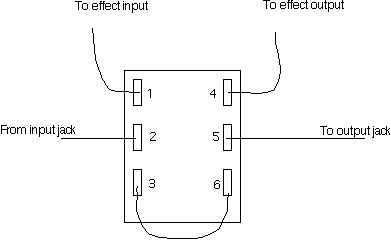
Bypass - How do I wire a DPDT
switch?
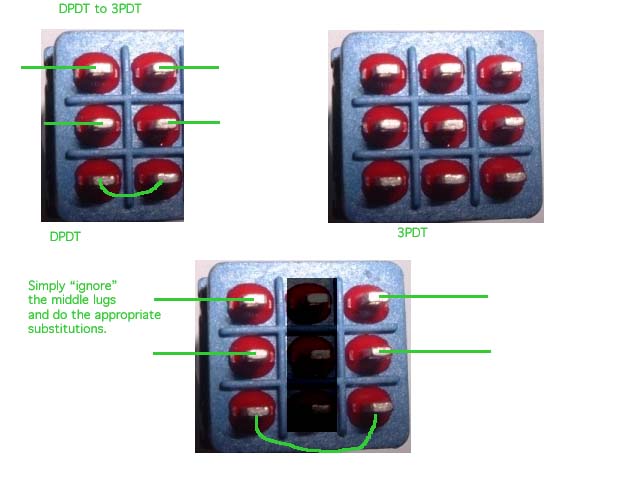
Bypass - I have a DPDT but I want to use a 3PDT instead; there are more lugs on the 3PDT, how do I do this?
Bypass - How do I wire a 3DPDT
switch with LED?
There are several ways depending on
whether you have a "standard" negative ground circuit (most circuits
are) or a positive ground circuit (like the Fuzz Face or Rangemaster). Positive
ground circuits have the RED wire from the battery connected to ground which is
opposite from most "standard" guitar pedal circuits.
For the standard circuits: standard wiring
and alternate (grounded input wiring) The grounded input wiring is probably better since it
grounds the circuit input when in bypass mode.
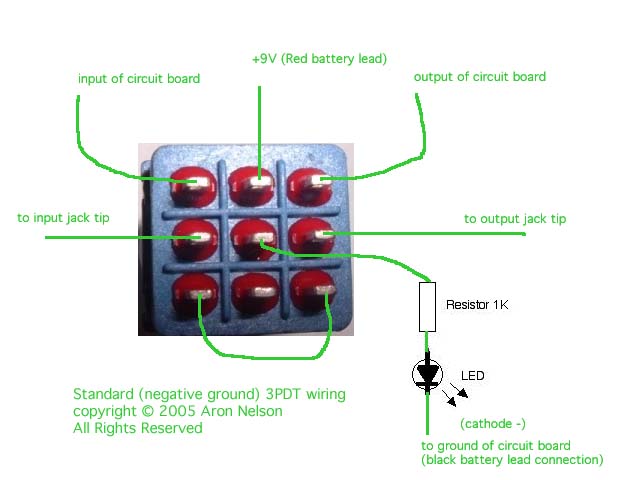
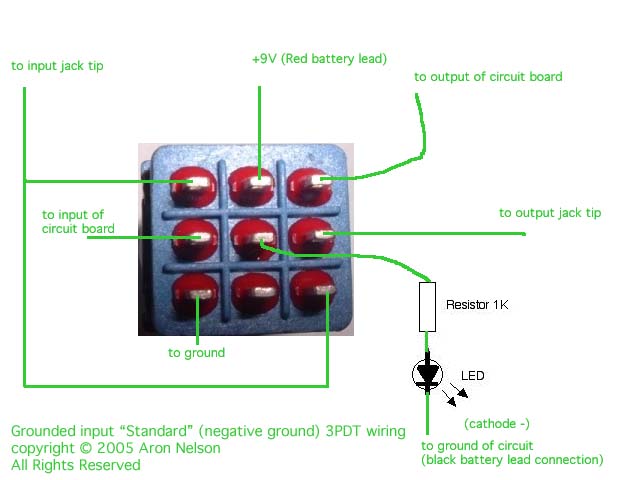
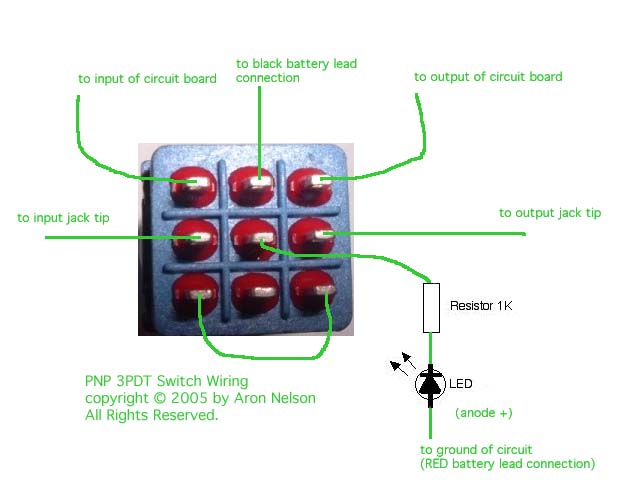
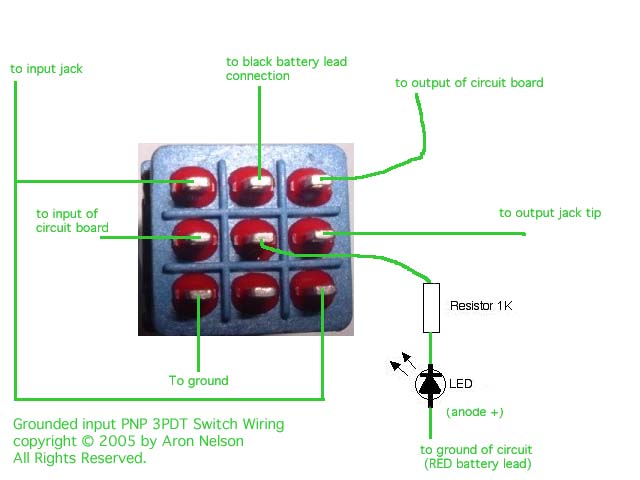
If you want to omit the LED, simply
ignore the middle set of lug connections and omit the resistor and LED.
Bypass - Where do I purchase a DPDT
or 3PDT switch?
Bypass - What's the deal with the
cheaper switches I see available... can I use them?
Yes. You can use any type of DPDT
stomp switch, the issue is reliability. As of 7/1/01, there is no better DPDT
switch than the tried and true Carling switches. The other "Arrow"
copy DPDT switches are fine for home use where you can swap them out anytime if
they fail (and most cheaper switches seem to fail). For gig use, I recommend
Carlings. I have heard the Fulltone 3PDT switches are good.
NOTE: I now use 3PDT switches
because they are much easier to wire for true bypass. I have found them to be
reliable as the Carlings I have and much cheaper. I make them available for a reasonable
price.
Bypass - I have an Ibanez Tube
Screamer and the switch broke, what can I replace it with?
From CJ Landry: The part is made by
E-Switch with the part number TL1100 and the Mouser P/N is 612-TL1100. I have
been using this part for a long time when replacing the TS-9 style switch. You
might want to add a second source. The second source is also a Mouser part made
by Mountain Switch. It's Mouser P/N is 101-0621. The difference between these
switches is the square top (on the plunger). The size seems to differ between
the E-Switch part and this Mountain Switch part. I have not looked at detailed
specs for each switch, but would try the switch which has a longer operating
life. This is the number of switch actuations it can handle before it fails.
They both work fine and I have no personal preference.
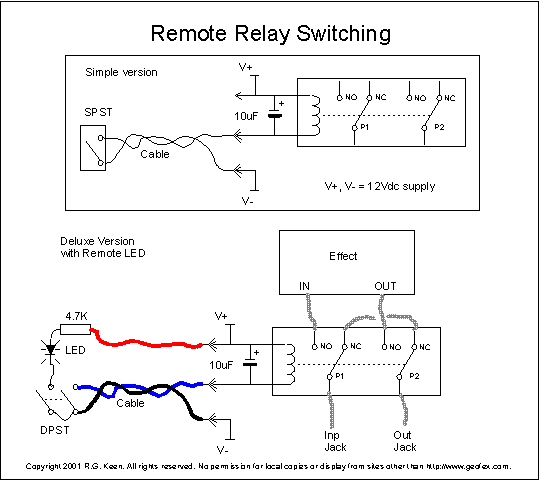
Bypass - have any info on relays?
DIODES

Diodes are polarized similar to
electrolytic capacitors; there's a positive and negative end. The cathode is
the negative end of the diode and the anode isthe positive. The main thing for
you to remember is that you need to orient the diode correctly with the
schematic.
LED is a light-emitting diode.It has
a cathode as well and it is usually marked with a flat side or dot or in some
cases a groove in the LED. Read
more about different LEDs. Sometimes
there is a longer and shorter lead. The shorter lead is usually the cathode
(negative), longer lead the anode (positive).
Misc - What is Si, Ge??? I see this
all the time?
Si = Silicon, Ge = Germanium.
Diodes - Give me a quick rundown on
basic diode types....
From Rob Strand:
You need to find at least one of
each types too have a look at. Most diodes of the same type look similar in
size. The size grows and lead thickness grows with increasing current handling.
Most diodes have a band at one end which is the cathode and many have a part
number stamped on them. Diodes can look similar but may be completely
different!!Here a _quick_ rundown on the key points:Germanium: 0.3V, low
currents, fast, usually clear+striped bandsSmall signal silicon: 0.6V, low
currents, fast, small glass, often copper coloured. Few variations:
blue/green/yellow stripes and no part number, black bands with part number,
multiple coloured bands and no part number.Power silicon: 0.6V, high currents,
slow, usually black plastic with silveror white band and usually a part
number.Power silicon-fast: 0.6V, high currents, fast, look same as Power
silicon.Small Signal Schottky: 0.35V, look like small signal silicon and
zenersLED: 1.8V, unmistakeable, different colours available.Zener: 0.6V one
direction and zener voltage in other direction,look like small signal diodes
but are often coloured witha part number stampedSmall diodes without part
numbers are very hard to identify exactly but are usually small signal silicons
or maybe zeners (if it has a number like 5B or 0A (for 5V, 10V) stamped on it).
How can I change the kind of
distortion I have - or make it more fuzzy using diodes?
When should I use silicon or
germanium diodes?
How do I wire a FET as a diode?
Anything more on diodes?
What is a low leakage diode and how can I find one?
What is a zener diode?
TRANSISTORS
You will have to work with
transistors in some stompboxes. The middle line is the base (B). One of the
lines will have an arrow, that's the Emitter (E), and the last line will be the
collector (C). If the arrow points away,it's an NPN transistor. If it points
in, it's a PNP.
 NPNTransistor
  PNPTransistor
Once you have identified the lines
on the schematic, you need to identify the pinouts on the transistor and match
them to the schematic. Refer to the diagram that comes with the transistor .
Lots of transistors use standard package types. Some transistors have unusual
pinouts so always checkthe diagram or obtain a datasheet on the transistor.
 This picture shows the FLAT side up of the transistor. You
will often see this picture in pinout diagrams. Sometime they don't tell you
this is the flat side...
This picture shows the FLAT side up of the transistor. You
will often see this picture in pinout diagrams. Sometime they don't tell you
this is the flat side... FETs
For all the circuits that use FETs,
I now recommend J201 FETs. At a very low cost, they are reliable and great! The
have the same pinout as the MPF102 in a TO92 case.
If you cannot get the J201, I also
recommend using NTE458 FETs instead of MPF102. The NTE458is about $1.80 around
here.
Here is an example of a FET in a
schematic that you might see:
 FET
FET
Note the G (Gate), S (Source)and D
(Drain) markings.
Many schematics will omit those
markings. Refer to this picture if you get confused.
TRANSISTORPACKAGING (Cases)
A common thing is for transistorsto
use a specific package type.
Here are some common pinouts for
some standard package types. Note that there are variations in pinouts and
variations of T092 etc... Check your datasheet, which describes the pinout of
your component.

I can't find a xxxxx transistor!
Where do I find a replacement/substitute???
Try this: go to [www.nteinc.com
www.nteinc.com],click on Semiconductor (for searching) and type in the
transistor number.If there is a replacement made by NTE, it will be shown and
you can look at the data sheet if it's online. Since NTE and ECG share the same
numbers, you should be able to find either NTE or ECGparts at your local
electronics store. Usually these replacements will work fine. Only in very
special circumstances will the replacement parts fail to work.
How do I find out the pin out of a
transistor or op amp?
For the most part, go to
[www.nteinc.com www.nteinc.com],click on Semiconductor (for searching) and type
in the transistor number.If there is a replacement made by NTE, it will be
shown and you can look at the data sheet if it's online. On the bottom of the
page will be a picture of the pin out. IN MOST CASES, the pin out will be
exactly the same as the original part. If it's different,the NTE web site will
note that the pin out is different.
Since NTE and ECG share the same numbers,
you should be able to find either NTE or ECG parts at your local electronics
store.
Also check out these datasheets:
http://www.mouser.com/index.cfm?handler=supplierpage Mouser's Links to companies.]
Also check out:
http://www.repairfaq.org/sam/semitest.htm Basic Testing of Semiconductors]
Misc - What is germanium? Where do I find germanium transistors and diodes?
Germanium is a metallic
semiconductor and early transistors and diodes were made from it. You can read
about the history of the transistor here. Some early circuits like the Fuzz Face and Tone Benders
used germanium transistors. You can find germanium transistors from NTE as well
as other electronic places. Small
Bear Electronics and my
store offers matched transistors for
building these circuits. The typically used germanium diode, the 1N34A is
available from my store.
Transistors - Can I just stick a
germanium transistor instead of silicon in a circuit?
In general, no. You need to rebias
the circuit for the germanium transistor.
What's up with this
"matching" transistors for Fuzz face type circuits? Do I have to do
this?
No, you don't have to match them,
but the circuit may not sound as good. It has been noted that matching
transistors in the Fuzz Face could give you that elusive sound that the highly
sought after Fuzz Faces had. GEO has a great article that explains this and
most boutique pedals carefully match their transistors by hand. Small Bear has
a great article as well! You can do this too. Just buy a ton of transistors and
measure each one until you hit the "magical" points on a couple of
transistors. Of course this could cost $$$. For a great alternative, utilize
the services of Small Bear.
You can also simple rebias your Fuzz
Face by altering the bias resistors.
Where can I find germanium transistors for Fuzz Face circuits?
How about buying some matched
transistors for a really great price!? Go to Small
Bear Electronics and order a pair.
Courtesy of Jack Orman:
Since the supply of 2N388A transistors have been depleted at
Parts Express, I thought I'd post a few alternate devices
that they carry that can be used for F-F construction. Any
of the below parts should be suitable and are less than $1
each. The last one is spec-ed a little weak but would likely
be okay. The first one is a good sub for the 2N388A.
Part No. Type Hfe Price
2N1306 NPN 100 $ .95
2N1308 NPN 150 $ .75
2N1309 PNP 150 $ .75
2N1373 PNP 60 $ .95
The NTE101 is another choice:
I've heard that the NTE158 might be another choice:
Darn it! I just bought a TON of NPN
Germanium transistors... I thought they were PNP. Can I use them?
Hah! This happened to me. Well, it's
pretty darn easy to convert PNP circuits to NPN. Reverse the polarity of the
Electrolytic capacitors, diodes and the power supply. It worked fine for my
Fuzz face and Tone Bender.... Very nice! (Note, this doesn't work for every
circuit, particularly high-gain circuits, but it's worth a try) For PNP to NPN
do the same. Reverse the orientation of all electrolytic capacitors, diodes and
power supply.
Why does my pedal have a horrid
crackling or "gating" sound when I play? I have to hit the strings
really hard to get it to make sound and it's horrible.....
You have a classic case of a
mis-biased transistor(s). Check out the Debugging page,
especially the section on bias problems.
What about biasing a silicon transistor?
How can I find out more about
transistor biasing?
From R.G.Keen:
By far the most comprehensive and
comprehensible book on transistor bias and gain that I've run into is
"Practical Transistor Circuit Design and Analysis"by Gerald Williams;
1973 McGraw Hill, TK7871.9.W53, ISBN 0-07-070398-1.
What about buffers?
What is the pinout of the
2N5088/2N5089?
E B C, flat side up, left to right.
I see 2N5088 all the time but it's
NPN, what's a PNP substitute for the 2N5088?
From R.G.Keen:
Use a 2N4250. 4250 is not exactly a
complement of the 5088, but it's pretty good for any silicon PNP uses.
The 2N5087 is also the PNP
complement of the 2N5089.
What is the pinout of the 2N5087?
E B C, flat side up, left to right.
What's a generic replacement for NPN
and PNP transistors?
From R.G.Keen: When in doubt, use a
2N5088 for NPN's and a 2N4250 for PNP's. You can purchase NPN and PNP
transistors from the store.
What's a replacement for the 2N5088?
From R.G.Keen:
2N5089 will work in most instances.
Also useful are 2N5210, 2N4401, BC549.
What FETs can I substitute in the
Mini-Booster and Shaka etc...? I can't find the J201....
From Jack Orman:
This is a recurring question eventhough
the information was in the Mini-Booster article at AMZ From the article:
"The NTE458 usually has more gain than the J201, and the 2N3686 can
provide gain of 500. The 2N5457, MPF102, and 2N3819 will produce less gain.
Other substitute transistors include 2N5484, 2SK43, 2SK68, 2SK117, 2SK118,
2SK121, 2SK163 and BF245."
What is the pinout of the J201?
It's the same as the MPF102 (see
pinout diagram at the bottom of this page). Flat side up, legs pointing down,
DSG from left to right.
Is there a general spec that tells
me if a FET has more gain or not?
From Jack Orman
"FETs with a low V pinchoff
usually have high gain. The Yfs (or Gfs) spec is a general indicator of gain as
well... Yfs of 1000 is low gain, 3000 is moderate and 12000 is smokin'" (Thanks
to Jack Orman for this tidbit!)
Where can I get a simple explanation about biasing a FET as an amplifier?
Read about a FET amplifier here at Graham Knott's page. (Thanks Mike B.)
Here's a great thread re: FET
biasing
Here are app notes regarding biasing
FETs
What is the pinout of the BS170?
Flat side up, left to right: D G S.
Note that the 2N7000 that is a substitute for the BS170 has a different pinout.
The 2N7000 is S G D flat side up, left to right and usually requires a
different value bias resistor from the BS170.
I see that a lot of pedals you use
have FETs, what other types of FETs can I use since I can't find many of them?
Here are some FETs that you can try:
2N5457, 2N5484, NTE458 , ECG458,or
J201. The J201 can be found at www.techamerica.com and Future(1800-655-0006).
The NTE and ECG FETs should be at most major electronic stores. The 2N series
can be found at www.mouser.comas well as all the other
places I list.
What's a good meter I can purchase?
How do I measure transistor gain?
The easiest way is to get a
multimeter that can measure transistor gain (hFE). The cheapest one I have
found is from Hosfelt: 9202-
Multimeter, just $12.95.
What is hFE?
RESISTORS
1/2 vs 1/4 watt resistors which
ones???
For most if not all of our stompbox
effects, 1/4 watt resistors are used. You can use 1/2 watt resistors but they
take up more space and do not provide any benefits. Yes, you can mix and match
1/2 and 1/4 watt resistors in a circuit.
What does 4K7 and 1K2 mean for
resistors?
"That is just the European
notation. They replace the decimal point with the multiplier letter.This
prevents the possible loss of the decimal point in transcribing data. For
instance, 4.7K = 4K7, 1.2K = 1K2, 1M = 1M and so on.
You'll also find the Euro use of
"nanofarads", meaning 1/1000 microfarad or 1000 picofarads.For
example, 0.001uF = 1nF = 1000pF. 0.022uF = 22nF.
It's handy, and less error
prone." (Thanks to R.G. Keen for this reply in the DIY forum!)
I don't have xxK resistor!
You can put two or more resistors in
series and their values will add up. The EMH has a
calculator for this.
I recently read somewhere that using
carbon composition resistors in an effect circuit would help to create
"brown sound". Are carbon comp. resistors really better to use for
audio circuits?
OP
AMP
I need to find that JRC4558 chip
that's in the TS-808, I heard you can get them from old radios and other voodoo
sources!
Yes, you probably can. Or, you can
buy the current chip that sounds the same as the original- so close you can't
tell the difference... from MOUSER.The part number is:513-NJM4558D.
What do all the letters after the
numbers mean at the end of an IC?
From Rob Strand:
General letter usage (not justTLO7x,
and all options may not be available):
The A and B refers to offset voltage
categories. Non-A/B versionshave the highest, then A, then B.
The C, I, M referes to the
temperature range, widening/increasingin that order.
The P, N, H, J refers to the package
type/material. Usually D means a surface-mount package.
Sometimes the different package
material implies different operating temperature ranges.
Basically you are safe with any of
these except D. For Audio projects usually the cheapest is OK. Using low
offsets, wider temp rangeand different packages _usually_ means you pay more,
and if you don't need the options you're wasting your money.
GENERAL OP AMP INFO
If the circuit uses an IC (usuallyan
op amp), then you will see something like this in the schematic:
 IC in schematic
In this case, you need to lookup the
datasheet for the op amp. Note that you can use a TL071 and have a great low
noise substitute for a 741 chip.
In this case, lets pretend it was a
TL072 op amp. Here's the pinout for dual op amps such as the TL072, JRC4558:
 Dual Op Amps have this pinout (TL072, JRC4558).
Referring to the IC in schematic
picture above, the wire going into the minus sign is the InvertedInput/pin 2.
The wire going into the plus (+) sign is the Non-InvertedInput/pin 3. Vcc
refers to the Vcc (+) input /pin 8. The groundgoes to Vcc(-)/pin 4. The wire
exiting the IC in schematic is the Output /pin 1. Since the TL072 is a dual op
amp, there are two sets of Input and Outputs. Sometimes circuits will use both
amps (inputs and outputs), sometimes it will use only one set. In both cases,
Vcc(+) and Vcc(-) will have to be connected. Vcc(+)goes to positive power.
Vcc(-) goes to ground. If only one of the op amps are used, the other set of
inputs and outputs can be left disconnected. In some schematics, the Vcc(+)
(power) and Vcc(-) ground will not be shown. This does not mean you don'thave
to connect these pins, you have to; the schematic writer is assuming you
already know this..
Let's look at a typical circuit
using a popular chip, the LM741. This chip was used in the MXR Distortion+, Dod
Overdrive and many others. Although widely used,it's a noisy chip. You can
replace the chip with another lower noise op amp like the TL072 if you are
building your own circuit. Note if you are modding an existing pedal, use the
TL071 - a direct chip replacement.
 example circuit using 741 chip
  <-lm741 chip="" font="" pinout="">
See how the -(minus) sign is the
Inverted Input? See the power V(+) on pin 7 and the ground which is pin 4 V(-).
To use a TL072 or equivalent, you need to map the LM741 pinouts to the TL072.
TL072 LM741
To use a TL072 instead of an LM741:
The connections that connect to
Output pin 6 of the 741 connect to pin 1 on the TL072
The connections that connect to V(+)
pin 7 of the 741 connect pin 8 of the TL072
The rest of the connections are the
same.
Always use IC sockets on yourboard.
That way, you don't expose the IC to heat when soldering and you can always
substitute a different IC later. For example you can try an RC4558 or TL082
etc...

WIRE
What kind of shielded wire should I
use?
If you can get it, single conductor
with shield - RG-174 Belden wire. Very good and it's flexible too.
What kind of wire should I use in my
pedals?
In general any type of hookup wire
will work - from size 22 gauge and smaller. (The larger the number, the smaller
the wire - so 26 gauge is skinnier than 22).I like the "pre-bondedhookup
wire" from Small Bear Electronics. It's a cross between stranded and solid
core - very nice. In general solid core will stay where you want, but will not
like being moved and can break easily. Stranded is much tougher but resists
bends and will generally not look as "neat" in an enclosure. Ifthe
circuit is being mounted in an enclosure and will not be removed- solid core is
ok. If the it's going to be moved at all, I recommend stranded wire or the
hookup wire mentioned above from SmallBear.
ORDERING
I live in another country, what's a
good place to order from?
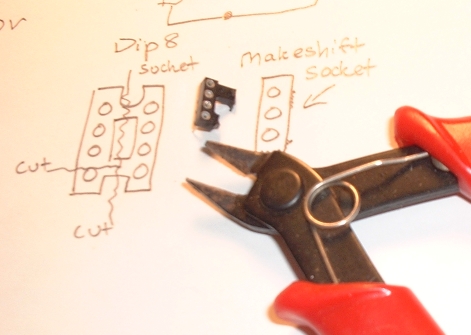
Where do you buy your transistor sockets from?
If you must purchase, I buy these:
Mouser part: 151-TO-1832OG. 151-TO-4320G and 151-TO-18320G. Most 3 pin sockets
will work fine. Most times, I simply cut up an 8pin DIP now.
Also see Small Bear Electronics.
Where can I get a printed circuit
board (PCB) layouts or ready-to-solder board (RTS) for effects?
ENCLOSURES
Where do I find the boxes to put
this stuff in?
Commonly called
"enclosures"in your favorite catalog, they are made by Bud, Hammond,
LMB etc...Aluminum boxes are easy to work with compared to steel. If you want a
solution that's cheap but a little harder to work with,check out electrical
outlet junction boxes. Thanks to Jack Orman for the tip.
I have been using the 1590BB Hammond
box that R.G. recommends. It is so great to build into a box that is sturdy,
has enough room and looks good. SmallBear Electronics is now offering the
1590BB for a very good price!. For a smaller box, check out these aluminum
enclosures.
MEASUREMENTS
How can I measure how much current
my pedal is drawing?
To measure the current draw of your
pedal, you put your meter in series with the power supply and measure the
amperage.
From F Peña:
You have to interrupt the circuit
measure current.
Do this: Set your DMM on DC/mA. Plug only the - side of the battery to the battery snap. On the + contact of the battery, touch the red probe and on the free contact of the battery snap touch the black one. You should get the reading on the meter this way.
How do I measure voltages in a
circuit?
Set your meter for DC, put the black
probe on a ground point and probe using the red probe. Read the DC measurement
on the meter.
How do I measure inductance?
Testing - I'm testing out a pedal I
made and I want to test it out with a function generator. What kind of signal
should I use?
From Zachary Vex. Put the output of the function generator on a scope, set it
for around 400 Hz, sine wave output, 100 mV peak-to-peak, and use a 47k
resistor in series between it and the input to your pedal. you can increase the
output to as much as 1 V peak-to-peak safely, i think, and you should monitor
the output of the generator on a meter or with one trace on the scope while you
monitor the output of the circuit with the other trace, if it's a dual-trace
unit.
Are there other tests I can do with just a multimeter?
Can I test a capacitor with my
continuity function?
You cannot test a cap with the
continuity feature. The continuity feature of most meters will only beep when
there is very low resistance.
See this link for more details:
again, thanks to R.G. for finding
this great link.
Impedance ... more in it
How to measure input impedance
COMMON
WORDS AND TERMS
See this section of the Wiki for a
list of commonly used terms:
Terms - What is PCB and RTS???
Printed Circuit Board and Ready to
Solder when related to stompbox electronic projects.
For example:
CALCULATIONS/FORMULAS
What is the formula for calculating
the knee of a RC (resistor/capacitor) circuit?
This can also be used to calculate
the rolloff of an emitter resistor/capactor.
From R.G.Keen:
A resistor and capacitor are halfway
to whatever they will do - highpass or lowpass - when the capacitive reactance
equals the resistor. That is, when Xc = 1/(2*pi*Frequency)=R, the filter is at
its knee. So with a little elementary algebra,Freq. = 1/(2*pi*R*C).
The units are ohms, hertz andfarads.
For the TS series feedback loop(for
example), this comes out to (1/F)= 2 * pi * (.000000047Farad) * (4700 ohms) =
.001387 Sec
F = 720.8Hz.
You can play games with the decimal
points. If you use C in uF and R in megohms, you get
F = 1/(2*pi*.047uf*.004700M)
=720.8Hz
But I prefer not to mess with
remembering special cases of uF/Mohm, etc. Just do it in farads and ohms and
keep the decimal point straight.
For emitter bypass capacitors:
From niftydog:
There are three factors that might
determine the ƒ rolloff. The input cap, the output cap and the emitter bypass
cap. The -3dB point is determined by the "worst" of these formulas.
For ƒlow due to Cin, you need to
know the signal source impedance and the input imedance of the amplifier
itself. Not a trivial excercise, so I won't go down that path, unless you
really want me to!
For ƒlow due to Cout;
ƒlow >= 1 / [2pi.Co(RC +RL)]
Co = output cap, RC = collector
resistor, RL = load resistor.
For ƒlow due to CE;
ƒlow >= 1 / [2pi.CE(re +RE1)]
CE = emitter cap, RE1 = non-bypassed
emitter resistance.
re is the dynamic resistance of the
emitter and can be approximated by;
re = 30mV / IE (±40%)
from Transmogrifox:
Here's the summary that has relevant
information that will get you into the ballpark:
f3dB ~ 1/ (2*pi*R*C)
and R is most significantly defined by the emitter output resistance, so ignore the rest of the effects and just calculate R as
R ~ Re ~ Ic/Vt = (Collector Bias Current) / (.025) at room temperature.
How to predict battery life
DEBUGGING
How do I debug and fix my effects?
I am getting a whine - like feedback
but high pitched when I turn the drive all the way up...how can I fix this?
You probably are running the leads
of the input and output too close or they are too long. Keep the leads as short
as possible when laying out your box. You may also want to consider using
shielded wire. To do this, shield the wire on one side only and then connect
the single conductor like usual. For high gain boxes, I recommend shielding the
input and outputwires from the jack to the switch and from the switch to the
board.
You can also try using a 3DPT switch
and using the outer connections for signal switching and use the
"inner" connections for LED switching.
Fixing Power Fried Pedals
Check out the thread on this. Great reply from R.G.
POPS
Pops when switching, even with
pulldown resistors
From R.G. Keen
There is a weak link in the power/ground setup in most
effects using stereo jack switching. You can get pops when switching the
relatively high LED current even if you have pulldown resistors on both input
and output caps.
The culprit is ground noise. The ground noise happens when
the sudden start and/or stop of current in the LED makes the signal ground
voltage change suddenly. +9V decoupling may not help, and may make it worse.
The ground noise comes from our friend, the stereo jack
ground switch. If your jack is new and the plug is new, things work great. When
dirt, oil, crud, bar funk, and other nasties build up on the ground ring of the
input jack and the second-channel contact that supplies ground through the plug
into the input ground ring, and thence to the effect board, the resistance
through that path can get high enough to make a noticeable pop when the LED
current starts and stops.
This sudden transient is worse with mechanical switches
because they really do go from fully off to milliohms of resistance in zero
time when the metals contact. The sudden "ground bounce" can flow
right into the input of your effect, and it doesn't take much to hear a pop
from the input of a gain-of-a-zillion MegaBlaster.
Also another thread on popping. [See
the post by R.G. http://www.diystompboxes.com/smfforum/index.php?topic=68210.0]
What to do, what to do??
(1) Clean your plugs and jacks. Yep, and do it again. And
again, every so often.(2) Use the OUTPUT jack for power switching - it's less
sensitive by the gain of the pedal.
(3) Use the GEO scheme for cold-switching +9V by using a PNP
transistor with it's base tied through a resistor to the stereo lug on the
input or output jack, and the battery minus tied directly to the board. The PNP
transistor only lets +9 through when its base is pulled down by the plug in the
jack, but this current does not change noticeably when the LED is started, and
so any ground bounce is only through the hard-soldered milliohms of the battery
lead, and is much, much smaller.
See the power supply switch in the Neutron filter at GEO or
at GGG, or see the positive 9V switch in [1] for how to hook up the PNP.
![[1]](http://geofex.com/FX_images/oaspltr.gif)
Measure for DC
PEDAL
SPECIFIC
Negative Ground with PNP Fuzz
circuit????
My LPB-1 cuts highs off of my
guitar. Anything I can do?
From: Matt Farrow
Pharaoh Amplifiers
There are a few things that you can
do to increase the treble response.
1. Switch to a different device. Any bipolar transistor will
have a characteristic high-frequency response and gain. Usually the higher the
gain of the transistor the more high frequencies it can amplify. Try a 2N5088
or 2N5089 for a start. 2N2222 can work but will be duller-sounding.
2. Increase the input impedance of the circuit. You can do
this by changing the biasing resistors on the base of the transistor, keep the
same ratio (on an LPB-1/2 it's usually 10 to 1, 470K to 47K - try 1M and 100K)
and also by inserting a resistor in series with the base (after the input cap
works better but try it both ways.)
3. Decrease the input cap to block low freqs. The stock .1
is too much for my ears unless you're using it for bass. Try a .047 or a .033.
Any tips for a Big Muff modder?
I want to mod my wah, any
information on this?
I finished building a Foxx Tone Machine (FTM) and it sounds great but I am having problems figuring out how the full wave rectification happens in the circuit. I have scoured my electronic books for some clue but to no avail.
From R.G. Keen:
Consider transformer rectification. A center tapped
transformer as in the Octavia makes two versions, one following the input
signal and one inverted in polarity from the incoming signal. The diodes allow only
the currently-positive version to appear at the output by each letting signal
through only when the signal feeding it is positive. This happens on alternate
half cycles, so you get full wave rectification.
In the FTM, the out-of-phase signals are generated in a
transistor phase splitter - the transistor with equal collector and emitter
resistors. The two diodes are biased slightly on by the resistors around them
so that the effect of the diode forward voltage is largely canceled out. But
each diode merely conducts when its anode is more positive than its cathode,
just as in the transformer case. The diodes think it's the same thing.
How can I increase the
"slope" of my filter and get rid of the fizziness?
- note* taken from a thread re: the Rat tone control...
From Mark Hammer:
The "Filter" control on the Rat is, as noted, a
single-pole adjustable lowpass filter that will roll off highs by 6db/octave
starting from around 475hz (when the pot is at maximum resistance of 100k) and
tunable up to 32khz (when the pot is set to minimum resisatance and the filter
is determined by the cap and 1.5k fixed resistor). Some folks, myself included,
find the upper range of the filter to be relatively useless, and so have
changed the filter cap from .0033 to .0047 (or larger). With a .0047uf cap, the
tuning range shifts to 334hz-22.6khz, which is a bit better.
But lets look at the bigger picture...
The purpose of such hi-cut filters is to take out the
fizziness and impart some warmness. Because the filters have such a shallow
slope (only 6db additional rolloff for every octave higher), you have to set
your rolloff frequency quite low to have any chance of attenuating much higher
frequencies to the degree you'd like.
Think of it like an aircraft carrier. How long would it have
to be to accommodate aircraft that needed a long running start to attain
liftoff? Fortunately we can shorten the "liftoff time" by opting for
a slightly more complex filter without drastically complicating or impairing
the circuit.
If one uses a dual-ganged pot as the tone control, it
becomes possible to create a steeper filtering action by having 2 poles
(12db/octave rolloff), so that you can have double the reduction in high-end
fizziness without having to remove too much of the "body" of the sound.
Moreover, the opportunity to cut high end more sharply means you don't really
need as much tuning range to achieve a noticeable variation in tone.
The Rat circuit assumes a total series resistance range of
1.5 to 101.5k. We could duplicate that but as noted, we probably won't need
that wide a range. I'm going to shoot for a tunable range of 3.3k minimum
resistance for each filter section, to a maximum of 53.3k. In tandem with a
.0033uf cap for each section, this gives a 12db/octave filter that can be tuned
from a rolloff point of around 900hz to around 14.6khz. If you like it slightly
darker, change the 3.3k resistor to 4.7k and your sweep range will be from
880hz to 10.3khz.
A dual 50k pot is pobably ideal, but lets assume they're a
little harder to obtain and work with a dual 100k pot (even RS sells them!).
The two pot halves are wired up identically as variable resistors (rheostat) in
series with each other, so that at one extreme their combined series resistance
adds up to 200k or thereabouts (and obviously 0 ohms at the other extreme). You
want their combined resistance to max at 100k, so put a 100k resistor in
parallel with each pot half to achieve 50k per pot section. The series resistor
doesn't really care which side of the pot it goes on as long as turning the pot
produces the same type of resistance change for each section. So, one fixed
resistor can go on the input to pot half A and the other on the output to pot
half B.
Instead of a single cap from series resistor to ground as
shown in the schematic, put a second .0033uf cap to ground at the junction
between the two series resistances (keeping in mind the location of your fixed
series resistors).
This change should produce no decline in max output level
(maye even a slight increase since you don't have to kill all the midrange to
eliminate the hi-end rasp), although whether a dual-ganged pot will fit in your
current chassis is another matter.
What's the deal with the limited
drive range on an MXR distortion+ clone I made?
TOOLS
Tools - What's a cool drill bit to
buy to drill these metal boxes?
Try a Varibit (possibly called a
UniBit as well?). These are stepped drill bits that cover pretty much all the
holes you need to drill. I bought the smallest size bit (1/2" max) and it
worked for everything up to footswitches. About $20 in my local store.
Typical mounting hole sizes
From (C.Garcia)
For the stomp switch 1/2" is OK
and for the jacks it depends on the style:
For switchcraft types is 3/8"
to 7/16" (other brands may be a little more or a little less, but within
the range)
For plastic types (Marshall style)
is 7/16" to 1/2"
What's a low-cost soldering iron I
can get
What's a low-cost soldering station
I can get?
How do I measure inductance?
How does an oscilloscope work?
MISC
What matters, what doesn't
Here's a link to a thread from our
forumers that explains what matters to them and what doesn't when starting out.
(Complete with colorful posts!)
How to use a breadboard
What is series, what is parallel?
How do I connect components in
series or parallel?
Series is one component after
another. Parallel is when both components are connected so that the components
are next to each other with the same leads connected to each other.

How do I put 2 components where
there is one presently? I heard
that I can put 2 diodes instead of one on my board and it will sound better?
How do I fit 2 diodes or components where there was only one?
There are a few ways, but here are a
couple.
The first way is if you have
vertical space. The second method is if you need to fit the diodes into a tight
space.
 Yes, the diodes are soldered in the "middle".
Bypass - I get oscillation/squealing
from my distortion when it's bypassed. How do I stop this?
Your pedal has such high gain, that
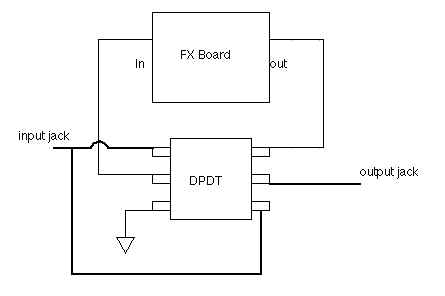
the input needs to be grounded when the effect is bypassed. Jack
Orman's alternate wiring method
does this. If you need an LED+input grounding, use R.G. Keen's Millenium 2 bypass with extensions.
misc - I am picking up radio
stations, how can I stop this?
From Eric Hensel: A 47pf cap
to,ground, after the input cap will probably do it --you can adjust this up or
down --higher values will start to cut treble. use the lowest value that works.
Mount the pc board as close as you
can physically to the metal box. this will serve as a ground plane to reduce
the heterodyning that can pick up rf. don't let the input and output wires
cross... make sure the layout doesn't allow input and output connections to get
too close to each other. if you can, solder in ground connections around (near)
the sensitive input circuitry. if rf is being picked up by rectification, these
fixes won't help, but if it is being picked up due to beat frequencies
generated by heterodyning (internal rf oscillation in the circuit beating
against rf from radio stations) you can get rid of it through the use of
careful layout and grounding to reduce oscillation.
You might try using miniature
shielded cable inside of the enclosure for the input to the board too.
Bypass - I get a pop when switching
my effect in and out. How do I stop this?
The typical method is to put a
"pulldown resistor" from signal to ground at the front and end of
your circuit. This is implemented as a 1 meg resistor from signal to ground.
Just put one at the beginning of your circuit board (before the input cap or
start of circuit if no input cap) and another at the end (after the output cap
or end of circuit). Look at the many GEO layouts
if you need to see a layout using these resistors. If you are not using high
quality switches, it could also be the switch.
Bypass - How do I make an LED that shows
if my effect is on? Can I do it using a DPDT?
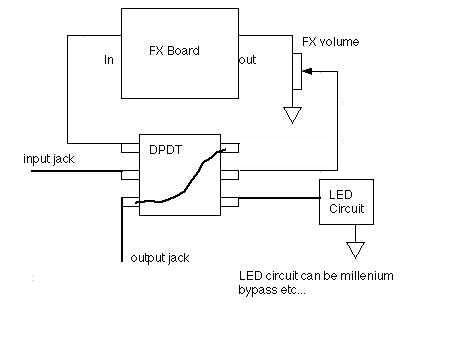
Yes! Check out the GEO Millenium Bypass.
I have used the Millenium Bypass with bothMPF102 and J201 FETs. The J201 worked
well with the white blinking LEDs I got from Radio Shack. The MPF102 worked ok
with the Red LEDs I used. Look at the very
clear diagram that Jack Orman wrote for hooking
up the circuits. If you make the Millenium Bypass, the wire labeled To Switch
connects to the DPDT switch. The +9Vdc connects to the plus terminal of the
battery or any +9V connection on the board. The Ground wire goes to any ground
on the board or the ground on the jack. The rest of the DPDT is hooked up like
the diagram that Jack
Orman wrote up.
Bypass - How do I figure out what
value resistor to use with my particular LED?
If you know the specifics of your LED, use the following calculators to figure
it out. Otherwise, start with a 1.5K resistor and increase the value to make
the LED dimmer or decrease the value to make it brighter.
Muzique.com LED Calculator
(Thanks Jack!)
Misc - What is a breadboard/proto board? Can I test circuits on this?
Yes! A breadboard/proto board is a
board with holes that are connected in preset ways. For instance rows of holes
will be connected (i.e. wired) together and all you do is stick components into
the holes. So to connect a resistor to a capacitor, all you do is stick the
resistor lead into a hole, then the capacitor lead into another hole that is
"wired" to the first.It's relatively easy to test circuits on a proto
board because you can easily substitute different components. The drawback is
that the proto board layout can end up not even remotely resembling the layout of
the perf board or PCB.
Do JFET circuits need a DC blocking
capacitor? I see some that don't have them.
From R.G.:
Most JFET amps, like most triode and
pentode amps don't need an input blocking cap under most conditions.
This is because the correct bias
voltage for most of these circuits is with the gate (or grid) at zero volts and
the source (or cathode)a few volts higher. JFETs, triodes, and tubes are
-depletion-devices which means that if you do nothing to them, they conduct
like mad. Bias for all of these devices involves holding the gate/grid-lower-
than the source/cathode to turn them partially off. Thisis most often done by
holding the gate/grid at zero volts and placing a resistor between the
source/cathode and ground.
At turn on, the gate/grid and
source/cathode are both at zero volts, so the current increases through the
drain/plate. This same current has to flow through the source/cathode
resistor,so it pulls the source/cathode up above ground, reverse biasing the
gate/grid a little. Eventually the source/cathode rises enough that the voltage
between it and the gate/grid is just right to keep that amount of current
flowing and so it stabilizes at that current. It's so-called self biased.
This is different from bipolar
transistors and enhancement mode MOSFETs. These devices are normally off, and
you have to do something to the control electrode to make them turn on a bit.
In any case, the correct voltage for
many JFET and tube circuits is zero volts DC on the gate/grid, and that just
happens to be the only voltage that doesn't need a coupling cap.
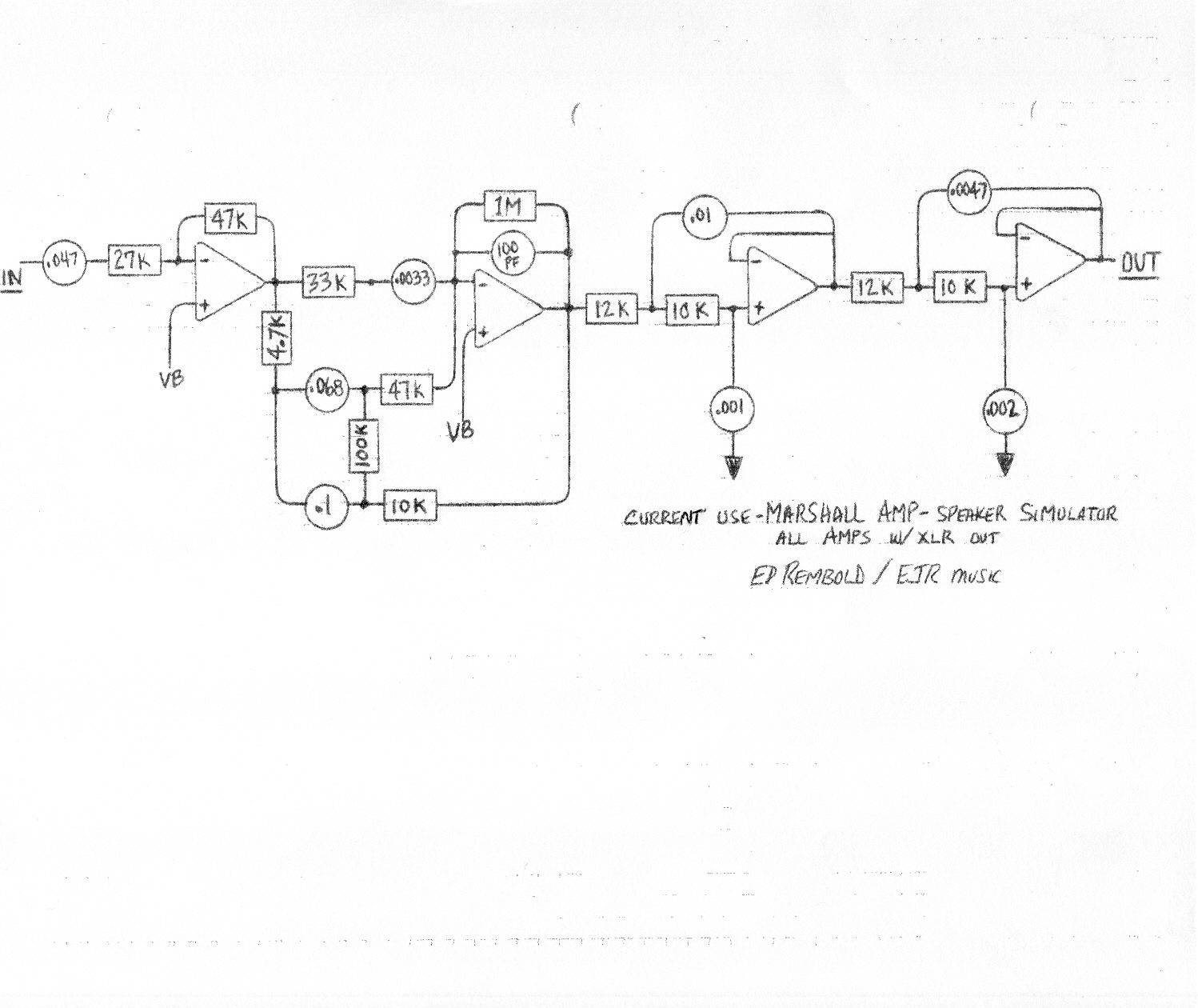
I wish I could make a cabinet
simulator; that way I could record direct and play through my boom box etc...
You can. Check out the Marshall type cabinet simulator. This does not replace a miked amp,but is usable and sounds
good when going direct.
How do I cut fiberglass PCB boards?
From Paul Perry:
I had to do this for a coulple of
dozen boards.. Found the best way was to get a 'tile scriber'which is just a
knife sized handle with a tungsten carbide point stuck on. You just clamp the
board with a metal edge on it &scrape away heavily a few times, then snap
on the scoreline. OK it's trivial & obvious maybe, but I tried to cut them
in a bandsaw, DONT even think about it, also fibreglass powder is BAD for your
lungs.
I would like to try and write out a
schematic of my effect. How do I do this?
What's an easy-to-use PCB program?
What can I use to view/create PDF
files?
What about layout software?
Where can I check out patents? I
would like to see what others have done before....
Try these:
How can I make my own knobs?
From R.G. Keen:
Easiest is to cast them from casting
resin or sculpt them from Bondo auto body putty or Sculpy plastic clay. Find
some plastic knobs you don't like, and break the plastica way from the brass
insert inside the knob to get the insert with its threaded setscrew.
For the bondo version, make a filler
plug of parafin wax to keep the hole to the threaded hole free and insert it
into the set screw hole. Wouldn't hurt to stuff the shaft hole full, either.
Then mix up the body putty, and
start building up the knob body. As the stuff cures, it goes through a
"cheesy" phase where it's really easy to cut and shape. Once it fully
cures, it is hard and solid, can be sanded to avery smooth surface or sculpted
by a Dremel with a burr on it.Then paint.
For the Sculpy (FIMA is anothertrade
name) just sculpt the stuff on the insert like modelling clay, and bake it according
to the directions when you get it right. Not as durable as Bondo, but easier to
work.
If the design is fairly simple,make
a wax model of the knob, pour plaster over it to make a mold,and then melt out
the wax. Pour in catalyzed casting resin until the level just supports the
insert, let it harden a bit to hold the insert in place, then do another pour
to complete the knob.As with the bondo, use parafin to keep the setscrew hole
and shaft hole free of the casting material and melt it out later.
Other people must have asked a ton
of questions about all sorts of stuff before right???
How can I make a Triangle Knob Big
Muff? Where's the schematic? Where's the schematic for a 70's Big Muff.
From R.G. Keen:
To the best of my knowledge, there
is no one schematic you can point to as *the* Triangle Knob Big Muff schematic.
EH freely substituted parts and values in all its pedals. Stories from original
buyers of various versions of the BMP and other EH pedals indicate that the
sound quality varied from unit to unit a lot even for the "same"
model.
There are 2 versions of traced
circuits from real Triangle Knob Big Muffs. As R.G. said, they are both
different.
What's up with the swell circuit on
the Foxx Tone Machine PCB?
From R.G. Keen: I should have saved
my comments on this when I originally posted them. The "swell"
circuit on the Prescription Electronics pedal is exactly the same circuit as a
1968(about) article in Popular Electronics by Anthony Leo about building an
entire distortion circuit, but it's modestly mis-used to take the output at a
place that has a DC level that starts high and drops to about zero over a bit
of time. It's also DC coupled out, so the DC level is transferred to the input
of the amp that you plug it into. This DC level pushes the input bias of amps
that are DC coupled at the input into not carrying signal. Since it's a
one-size-fits-all kind of thing, it only works right for amps which have
(a) DC input coupling
(b) about a 2V range before being pushed into saturation or
cutoff on the input
(c) NO DC coupling to the speakers!!! Do this on a solid
state DC coupled and and you'll fry a speaker. Many tube amps have no input
coupling cap, about a 2V range, and are AC coupled, so they work OK. SOME solid
state amps are close enough, and can work OK. Some don't work well at all. Oh,
yeah. The "swell" circuit only works right when you have very fresh
batteries. Older batteries don't make the happy-accident level changing work
right. When it works, the volume on each note starts quiet and ramps up to full
level, kind of an attack delay. The Experience Pedal is just the Foxx Tone
Machine circuit followed by the A. Leo Fuzz circuit, and some very, very
complex switching.
I have an old 3 knob memory man
delay, NOT STEREO. I play it and it passes signal when on and off but no
effect. Do you guys think it is the rare mn3005 delay/chorus IC gone bad???
From Mark Hammer
The chip may actually be okay, but
you may need to do an adjustment to find out. There should be a trimpot near
the MN3005. It provides a DC bias voltage that the audio signal has to ride on
in order for the chip to pass the signal through. Sometimes, the trimpot gets
knocked out of position or just drifts over a period of time. It may *sound*
broken, but is simply not set up correctly anymore. If you can find this
trimpot, slowly turn it while you play or feed an audio signal in to the MM. At
some point, you should hear the audio signal if the problem is as I describe.
MISC
LINKS
Is there a simple site explaining
components?
Check out this site about
components....
Is there an article explaining how
to solder?
Here's a nice
tutorial on soldering!

What kind of solder should I get?
For fine work, you get thin solder
usually 60/40. However check out this thread from the forum. Try out 63/37.